BLOGGER TEMPLATES AND TWITTER BACKGROUNDS »

Sunday, June 6, 2010

Major Shifts in the College Sports Landscape

 Here's four little snippets to begin my post today:

1.  The Big 12 announced today that Nebraska and Missouri have until Friday afternoon to state whether or not they intend to stay in the Big 12, or move to the Big 10. 


2.  The PAC-10 chancellors and presidents have given PAC-10 commissioner Larry Scott "all the authority he needs to expand the PAC-10."
3.  The maelstrom of speculation on whether or not Texas will join the Big 10 hit a high point
4.  The SEC has flexed its muscles and said that "will not allow ourselves in any way, shape or form to be anything less than we are now."


What does this mean?


Money is king.  It's all about the Benjamins. 


Pretty soon, we're going to have a 16-team super league out west (The Sunny 16), a colossus conference in the midwest (The Big and Beefy 14), and a southern faction of heavyweights (The Even-Bigger-Yet-Ridiculously-Speedy 14) that will dominate the college sports landscape. 


This will leave the Big East, ACC, Conference USA, Mountain West scrambling to keep up as the other four major conferences that make up the "BCS" schools. 


In the wake of those other four filling vacancies and adding their own firepower, mid-major conferences such as the Mid-American, Western Athletic, and Sun Belt will be left in the dust, and an even bigger separation will occur between the BCS and the Best-of-the-Rest. 


This isn't the first time that expansion has happened, but its the first time I can think of that such a large-scale, money-driven poaching has occurred.  This undoubtedly will add firepower to the argument that the BCS has a monopoly over college sports.


How will smaller conference schools, such as Ohio, ever be able to catch up at this point?  Will they ever be able to challenge for a national championship in the next 10 years?  20?  100? 


The answer, unfortunately, is no. 


Granted, there may be an opportunity for Ohio to move up to, say, the Big East, but will the Big East be relevant in 5 years?  How about Conference USA?


This whole situation spells doom for small conferences, since the rich will only become richer. 


I don't know what's going to happen, but I know that it can't be good.  Not good, at all. 

Saturday, June 5, 2010

Jackets Offer Boucher Head Coaching Position

News leaked yesterday that the Columbus Blue Jackets have offered Guy Boucher their open head coaching position, despite no official word from general manager Scott Howson or the Montreal Canadiens, Boucher's parent club.  

Boucher, currently the head coach of the American Hockey League's Hamilton Bulldogs, is one of the hottest coaching commodities in all of hockey.  He lead the Bulldogs to a 52-17-3-8 record, best in the AHL Western Conference.  Hamilton made it to the Western Conference Finals, where they fell in seven games to the Texas Stars.

This offseason has been accepted by all Jackets fans and analysts alike as the most important in franchise history. 

When former coach Ken Hitchcock was fired in February, only ten months removed from taking the team to the playoffs for the first time, it sent a message that mediocrity was no longer acceptable in Columbus.

Howson's decision to offer to Boucher is not surprising to anyone who has followed the Jackets' coaching search the last couple of months.  What is relatively unfortunate, however, is that this news was leaked before a coach actually signed a contract.  

Blue Jackets beat writer TOm Reed mentioned in his latest blog post, and I agree, that Boucher's decision will make or break the franchise.  The embarrassment of Boucher turning down the job could cripple the credibility of the franchise for years.  While there are plenty of capable alternatives, like Scott Arniel of the Manitoba Moose, Kevin Dineen of the Portland Pirates, and associate head coach Claude Noel, Howson's decision to go with Boucher signifies a leap of faith.
Boucher is unproven at the NHL level, and his 1-3-1 forecheck and powerplay system would be highly experimental at the NHL level as well.  There's worry it may not even work.
But, a pick like Boucher would send a message to the fans that the youth movement in Columbus will carry the franchise for the next five to ten years.  Boucher, at 38, would be the youngest coach in the NHL, and he would carry a lot of weight with the younger guys in the locker room like Nikita Filatov and Derick Brassard.
Boucher is expected to let the team know of his decision by next week, so this weekend will be, with all certainty, the end of the Doug McClain era in Columbus, because the new coach, whoever it may be, will most likely clean house, and with that, all of the remains of the decisions of the man that hindered the Jackets' ability to be successful.  


Friday, May 28, 2010

Finding Your Field of Dreams


ESPN reported two weeks ago that the legendary Iowa farm that was used in the movie “Field of Dreams” is for sale. 

Now, YOU can own a piece of sports movie history for the low, low price of…$5.4 million. 

The majority of the inquiries have stated that the field would remain intact.  Then again, I’d hate to be “that guy” that decides to buy the farm and tear down the baseball field. 

“What’s your point?” is the question you are probably asking yourself right now, regarding my post. 

I guess I’m just glad that people realize the need to keep the field.  It may just be a movie set, but it is an iconic part of what makes sports so great, and so necessary. 

The field was built in the movie because Kevin Costner’s character, Ray Kinsella, heard a voice that told him “If you build it, he will come.”  This line itself is one of the most recognizable movie lines, ever.  But it goes deeper than building a baseball field.

Kinsella builds his field, despite ridicule and contempt from everyone but his wife.  After seeing historical baseball figures come out from the cornfield and play on his field, he finally gets to play catch with his father in the end, making it quite clear why the divine messenger sent that iconic message.  This is a really, really brief explanation of the movie, I recommend watching it from beginning to end to truly understand the message of the movie.   

This baseball field represents the ultimate sign of faith.  Kinsella placed everything he had on this one bet, and despite the hardships he faced, he was rewarded in the end.  Not so much economically, but emotionally, and spiritually. 

Sports are our release from all of these hardships.  Even in times of economic despair, sports teams are still selling out arenas and bringing cities together, one game, one play at a time. 

Look at the 2001 New York Yankees’ run to the World Series.  Following 9/11, New Yorkers were united under two banners:  FDNY/NYPD, and the infamous pinstripes of the “Bronx Bombers.”

In situations like that, sport transcends its recreational value, and makes us all realize there is a light at the end of the tunnel. 

High school football and basketball shut down many of the small towns across the country for hours at a time.  Completely shuts them down.  Everything closed.  When was the last time you can think of something like this happening?

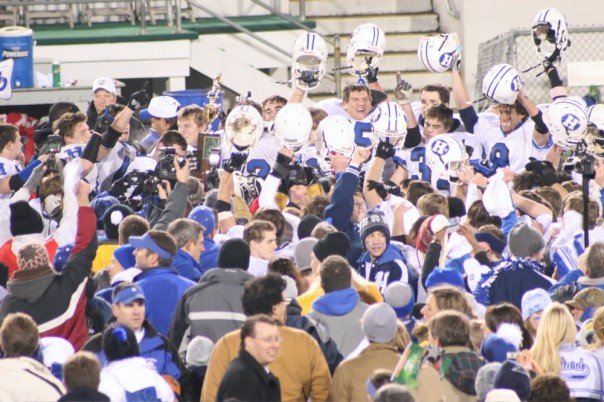
Some of the greatest moments in my life have been sports related.  Watching my high school football team win our first state championship my senior year (and again this past year), being in the crowd for the first ever Blue Jackets home playoff game, watching Ohio beat Georgetown and storming up Court Street afterwards, and hopefully, watching Ohio beat Ohio State for the first time ever in September (Wishful thinking, but it’ll be my birthday)

In sport, there is always someone to root for.  And because of that, its value is intangible.

Wednesday, May 26, 2010

Ohio Athletics vs. Ohio Faculty

For the last couple of weeks, the Ohio University faculty senate and the Ohio University Athletic Department have traded jabs in the battle over budgeting.  

The faculty senate is under the impression that downgrading athletics is necessary because the athletic department continues to operate over-budget year after year.  
Yes.  This is true.  The athletic department IS operating over their allotted budget.  But, does that make it OK to downgrade athletics?

Absolutely not.  
Athletics, just two months ago, brought the university FREE national publicity in the form of a FRONT PAGE picture on USA Today, highlighting the epic win the men's basketball team had over the Georgetown Bulldogs.  Not to mention, a large portion of the country saw the game because it was on NATIONAL television (More free publicity)
The football team did much of the same thing, going to the 2009 Little Caesers Bowl, and playing on national television for the SECOND time in a month (The 'Cats also played in the MAC Championship game, which was shown on ESPN earlier in December)
And how about we ask the students what they want?  Ask each individual that stormed onto Court Street on March 18 what they think about athletics.  Ask those kids that skipped classes to drive to Cleveland and watch the MAC basketball tournament.  And ask the kids that drove 12 hours to Providence why they did so.  

The faculty should definitely be concerned with the budget, and they have every right to try to help the university be as successful as possible.  But, this is one fight they shouldn't try to continue, because athletics is important to so many people.
How many alumni would stop giving money if there were no longer a Division 1 basketball team in Athens?  How much revenue would Ohio lose if they couldn't sell football tickets anymore?

Too many questions that I don't want to know the answers to. 
Honestly, I don't think athletics should be too worried with Dr. McDavis declaring that athletics would be safe not too long ago, but the stubbornness of the faculty senate and their inability to see the glaringly obvious positives makes me wonder what their agenda really is. 

Alright.  End rant.  

Thursday, May 20, 2010

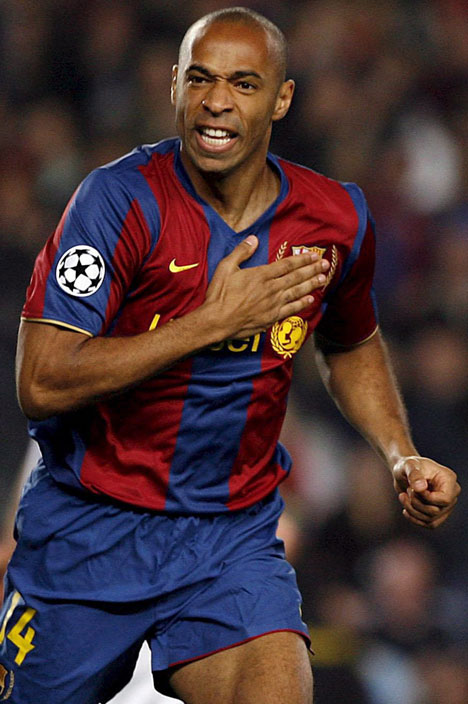
World-Class Striker Thierry Henry Contemplating MLS Run

A couple of days ago, Barcelona striker Thierry Henry agreed to a deal with American side New York Red Bulls following the World Cup in South Africa.  

Henry, who has led the English Premier league in goals scored four times in his career, is currently under contract with Barcelona of La Liga in Spain, so there is no certainty as to when the Frenchman would make his debut under the lights of New York City.  
What does this mean for Major League Soccer? 

Honestly, it's bigger than David Beckham signing with the Los Angeles Galaxy in January 2007.

Beckham was the pretty-boy star of the Galaxy during his MLS tenure, but in my opinion, he was outshadowed on the field of play by teammate Landon Donovan, arguably the best American player of our generation.  

Beckham brought the celebrity spotlight to the league, but he forgot to bring with him the crosses that made him the world's best footballer for several years.  He also feuded with Donovan, and eventually lost the support of his own fans in Los Angeles.  

Henry is still a good enough player to come in and dominate MLS if he so chooses.  At 32, he may not be as fast as he was five years ago with Arsenal, but he is still nimble on his feet and can find the net.  He has scored 49 goals in 116 appearances with Barcelona.  

Henry would step into a situation where he could be the immediate leader of his team.  Only Juan Pablo AngĂ©l is close in name recognition on a squad that has sorely underachieved thus far during the 2010 campaign.  He would provide the goal scoring necessary to push New York towards a playoff run.  

While many fan's of American soccer still have a bitter taste in their mouths following the departure of Beckham to AC Milan, the signing of Henry would re-energize a club desperately in need of some help, and continue to make MLS more relevant to soccer fans across the world.  

However, I must caution, it is imperative that Henry find success in MLS, whether it be leading the league in goals or winning a championship.  He needs to prove to the rest of the world that this isn't a publicity stunt, and that he intends on improving American soccer.  

If he can do that, Henry may very well be one of the most influential players the league has ever seen.   

Saturday, May 15, 2010

Ohio State to Help Manage Nationwide Arena

According to The Columbus Dispatch, Ohio State and the Columbus Blue Jackets have agreed to a pact that will allow Ohio State to help manage Nationwide Arena in efforts to lower expenses for the financially troubled hockey franchise.
The one-year deal will keep bidding wars for concerts and other promotions from driving up expenses for both Nationwide Arena and Ohio State's Value City Arena.

In the past, the two arenas competed for the same concerts and in many instances, paid upwards of $200,000 just for hosting rights.
The deal will allow the Blue Jackets to save around $1 million dollars a year on operating expenses, but the club will still have cuts to make in order to operate in the black for the first time in franchise history.
In my opinion, this deal couldn't come at a better time for the Blue Jackets.  

Because Nationwide Insurance owns 90 percent of Nationwide Arena (The arena was privately funded after Columbus citizens voted down a tax increase to pay for the arena), they have charged the club around $5 million a year for rent and the use of a management company.
 
The Jackets are locked into a lease that causes them to bleed money and prevents the club from making advances towards productivity in Columbus.  
I believe that too many Columbusites take everything this team has provided the city for granted.
Before the Jackets, the current Arena District was nothing more than beaten buildings, ugly, unused properties, and a looming, distraught-looking state penitentiary.  The Jackets have brought life to the downtown that hasn't been seen in my time as a human being.
With the completion of the arena came LifeStyle Communities Pavilion in 2001, a state-of-the-art concert facility where I went to prom my junior and senior years (It was awesome).
In 2009, Huntington Park opened as the new home of the Columbus Clippers, the AAA affiliate to the Cleveland Indians.  The baseball stadium has won awards on many occasions and has added to the glow and beauty that has become the Arena District.
Many citizens vehemently oppose having to pay for the Jackets, and think that the club should move elsewhere if they cannot afford to stay in Columbus.
In all honesty, you folks are wrong.  If the Jackets do leave, you'll finally realize what they have been giving to our city for these past ten years.  They've made our downtown attractive again, and made downtown Columbus a destination, and not an eyesore.  They've made it safe.  They're bringing families to Columbus and its suburbs.
Not to mention, it's turning Columbus into a hockey town.  High school hockey has grown exponentially since the arrival of the Blue Jackets, and there are more kids in Columbus playing hockey than ever before.  

Those are the intangibles.  I challenge you, the citizens of my city, Columbus, to take a look inside and ask "How would our city look, and feel, without the presence of the Blue Jackets?"

Thursday, May 13, 2010

SportsNation: The Darling of ESPN?

Although I don't exactly know when the SportsNation section started on ESPN.com, I started visiting it when the television program "SportsNation" made its 3:00PM EST debut on July 6, 2009.

Since then, the "Average Joe" has been able to make his or her opinion heard on ESPN, extensively through the use of Twitter, and polling through the SportsNation page on ESPN.com.  

In my opinion, ESPN has completely blown away other mainstream news sites such as CNN.com and NYTimes.com in terms of interactivity and usability.  Quite simply, ESPN is allowing the users to determine an entire hours worth of programming every week day.  

I like this.  I like this because no longer can the elite sports journalists of today sit on their pedestal and declare themselves the rulers of the collective sports galaxy.  

Colin Cowherd, one of the anchors to the television program, has been known to ruffle some feathers as one of the pretentious sports personalities at ESPN.

While I disagree with the great, outstanding majority of his opinions on many, many topics (LeBron, soccer in the United States, hockey, mid-major sports, just to name a few), his time on SportsNation seems to have made him realize that the sports fans of America speak louder than he does.  

I cannot factually state that his opinion has always been different than the majority of sports fans out there, but I can say I've seen him lambasted on the air by his co-host Michelle Beadle (I would marry her in an instant, just throwing it out there) because of his grossly exaggerated opinions on many topics.  

Now, once you get past that Michelle is a strikingly beautiful woman who definitely knows more about sports than I do, you realize that she represents all of us, and says all of the things that we wish we could say to personalities like Cowherd.  

She stands up for the voice of the "Average Joe," because it deserves to be heard.  

What does this mean for sports personalities, on any medium?  You better be careful and do your homework, and you had better not ruffle the wrong feathers too often, or you are going to be called out on it, and in a very public manner.

Journalism is heading down a new pathway, one that isn't under the shroud of closed culture newsrooms and elitism.  The "Average Joe" isn't so average when he is allowed to 1UP-Mario style and become a part of something bigger and better.

I think the big time media should look towards ESPN as an example of effectively using their audience as a means to create better content.